Translated from 百度贴吧, original author is Asmobia.
2002 Current Chinese Weiqi Rules
Chapter I: General Provisions
Section 6: Prohibition of global homomorphism
The next move can’t cause a repeat of a situation that has occurred before.
Let’s assume that komi is set to 7 while black first(This will allow the draw, but the draw is not the issue, the key is the best process what is the strongest resistance), please see the picuture below.
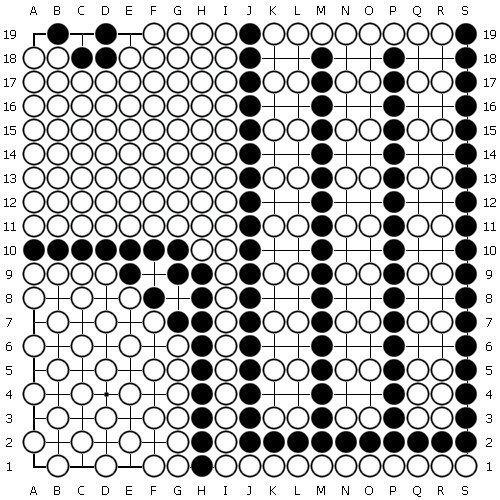
There is a seki on the right side, which includes twenty-two “perfect ko threat” for the black. The so-called “perfect ko threat” has the following two properties:
- The opponent can’t solve the ko threat in advance and can only deal with it passively. You can see that White cannot take the lead on the right side in any case. If White tries to move on the right side first, then Black will kill it just by moving on the right side continually.
- When you try to start ko with the ko threat, even if your oppenent reply to it, you will not lose the number of points. Hence you can use the ko threat without cost.
There is a seki of “capture two recapture one” on top right corner, the territory is too huge to be lost by white.
The twenty-three eyes on bottom left corner is compeletly regarding as a living grounp, but owing to in the situation of “Prohibition of global homomorphism”, “capture two recapture one”, and twenty-two “perfect ko threat”, it eventually die!
Process starts:
-
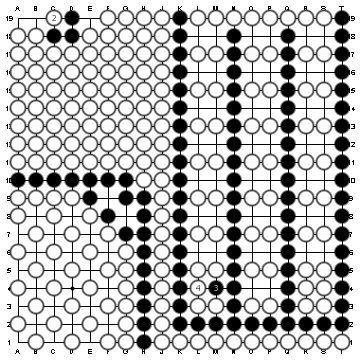
On top left corner the move black 1 throwing in, absolutely the move white 2 capture two; However at the moment the move black 3 take ko threat on the right side, white 4 must reply to it, otherwise the seki will be broken. The four steps are imperative.
please remeber the whole board after the move of white 4, it’s the key of prohibition of global homomorphism.
-
After the move of white 4, the move black 5 recapture one stone on the top left corner.
Please pay special attention, if at this time white pass the move of white 6, black 7 would throw in on the top left corner and white cannot caputre two back due to the prohibition of global homomorphism! If you don’t believe me, you can compare the position after White 4 in the picture above, which is the same as the position after White 8!
For avoiding the issue, white must make a move of white 6 on the board anyway. The question is, which move is the best? The upper left cornner is absolutely impossible to move, as a move would result in broken seki; The right side cannot be moved either, owing to the same reason as the upper left corner. Therefore the only choice for white is to fill in eye on the bottom left corner.
White has filled in its own eye, though black still throw with black 7, as shown below.
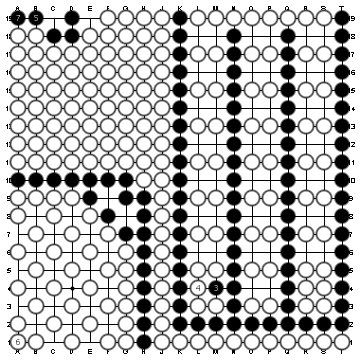
- Black 7 thrown in the upper left corner, white must capture the two with white 8; however, at this time, black put black 9 to take advantage of the ko threat and white must reply to it. Now it enters a next circle…
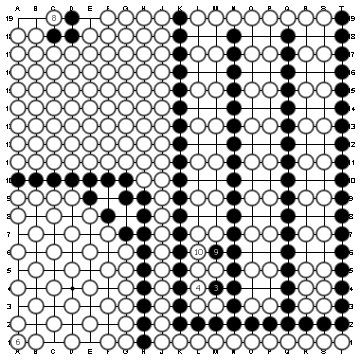
- Black can make twenty-two moves on the right side, adding the “capture two recapture one” on the upper left corner, to force white to fill in its twenty-two eyes on the lower left corner. White having only twenty-three eyes on lower left corner, it has been capture all after filling in twenty-two eyes. although black cannot make a move on right side, as well as the “capture two recapture one”(if in the situaton of having no ko threat black start the “capture two recapture one”, he will face the issue of prohibition of global homomorphism first). Therefore both of them pass, the game thus ended. Minus Black’s agreed-upon komi of 7, they draw.
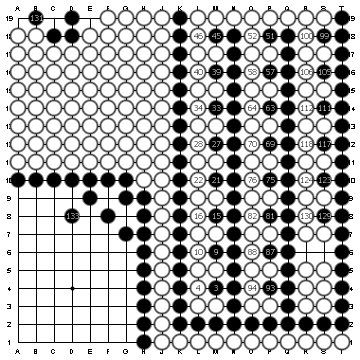
Therefore, under the current Chinese rules, the best course is a draw between the two players. Owing to the restriction of forbidding global homomorphism, White’s 23 eyes in the lower left corner are dead in the best position and must be filled in.